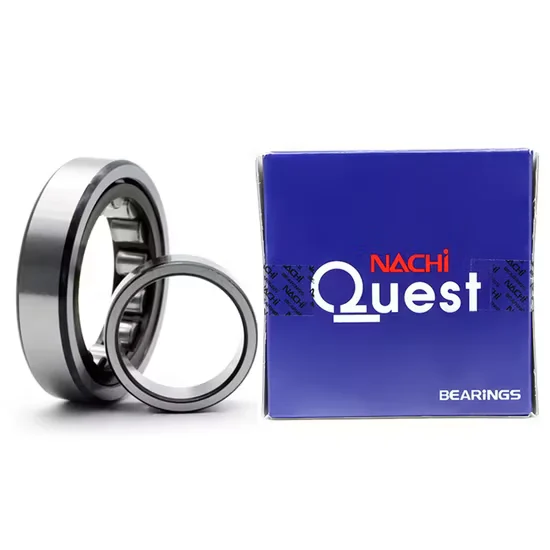
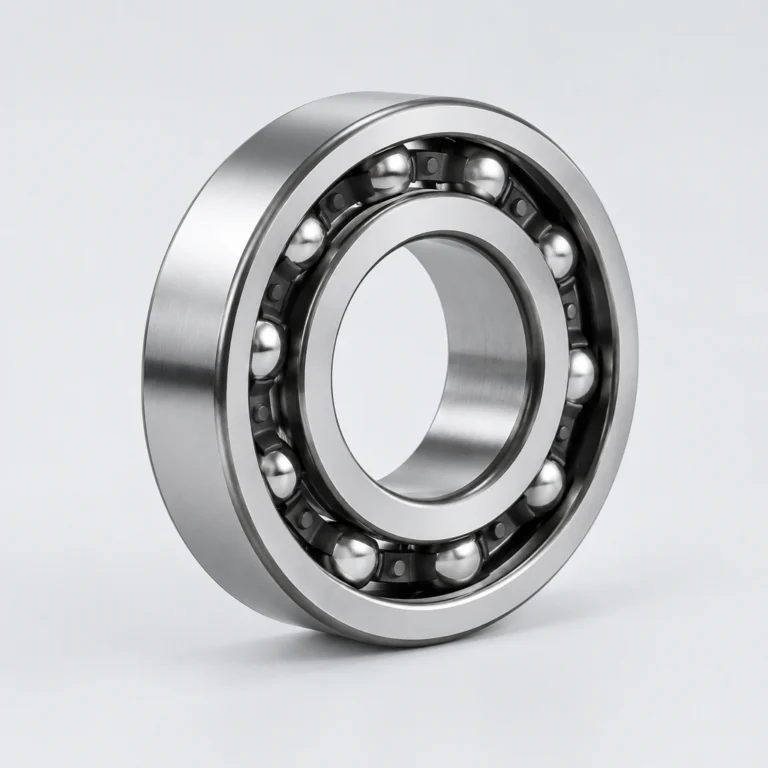
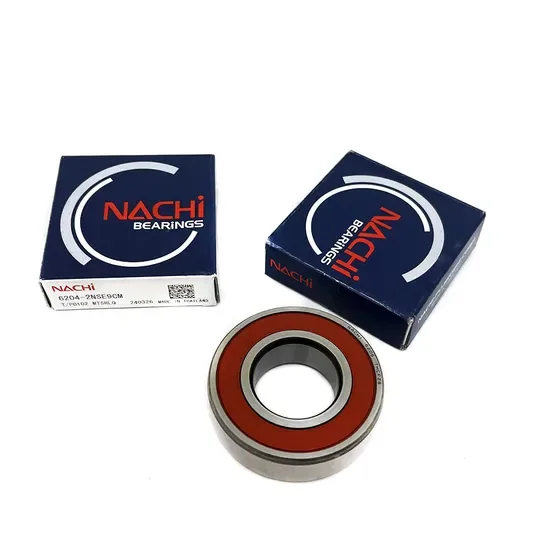
Original Batch Traceability — Every N410E unit ships with factory lot documentation linking directly to the Japanese production run.
Technical Specifications
| Parameter | Value |
| Designation | N410E |
| Product Type | Cylindrical Roller Bearing |
| Bore Diameter (d) | 50 mm |
| Outside Diameter (D) | 130 mm |
| Width (B) | 31 mm |
| Material | Bearing Steel (standard) |
| Load Direction | Radial Bearing |
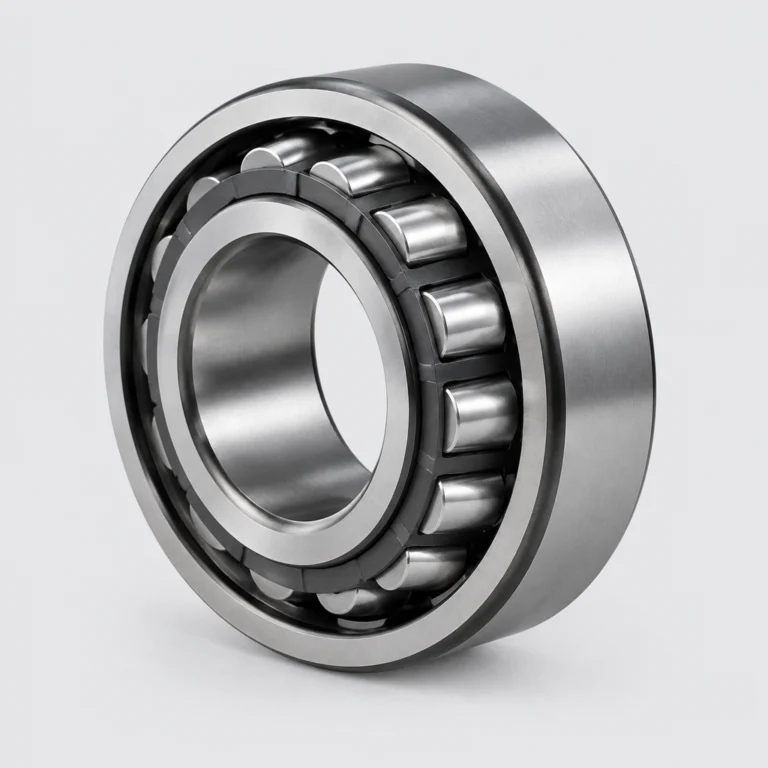
| Separated | Separated |
| Seal or Shield Type | Open |
| Lubrication | Oil / Grease / Dry |
| Precision Class | P0 P6 P5 P4 P2 |
| Number of Rows | Single Row |
| Origin | Japan |
Application Suitability
| Industry | Typical Applications |
| Heavy Machinery | Heavy-duty gearboxes, rolling mills |
| Industrial Equipment | Machine tools, pumps & reducers |
| Traction Systems | Traction motors |
Why the Open-Type NACHI N410E cylindrical roller bearing Fails in High-Heat Gearboxes
Thermal expansion without adequate internal clearance causes the rolling elements to bind and overheat.
During my time analyzing failures on palm oil press lines in Indonesia, I frequently pulled out cylindrical roller bearings where the rollers were completely scorched blue. The root cause was almost always a standard clearance selection in an environment that demanded extra internal room for heat dissipation. When the housing expands faster than the shaft, the internal gap vanishes, leading to catastrophic friction and immediate seizure. Procurement teams often focus solely on the dynamic load rating, completely ignoring how the ambient and operational heat will physically alter the internal geometry once the machinery reaches its steady-state temperature. This oversight transforms a perfectly engineered component into a mechanical fuse that destroys the entire drivetrain.

Matching the Enhanced Design to Radial Load Demands
The reinforced internal geometry of this NACHI N410E cylindrical roller bearing handles the intense radial forces found in heavy-duty gearboxes and rolling mill drives. Our engineering team regularly cross-references these specific load profiles against equivalent models to ensure the enhanced design perfectly aligns with your torque transmission requirements. This prevents the premature spalling often seen when standard-capacity bearings are pushed beyond their dynamic limits under shock loading conditions. By carefully evaluating the specific vibration signatures and load zones of your equipment, we can confirm whether this specific reinforced configuration will provide the necessary fatigue life or if a different internal arrangement is required to handle the complex stress distributions present in your application.
Thermal Expansion and Lubrication Challenges in Continuous Operation
Continuous operation in rolling mills and heavy gearboxes generates significant heat, directly impacting the internal clearance and lubricant viscosity. An open seal configuration requires a reliable external oil or grease circulation system to flush out metallic debris and maintain a stable hydrodynamic film across the rolling contacts. If the lubrication interval is ignored or the flow rate drops, the boundary friction spikes, rapidly degrading the raceway surface and accelerating fatigue. Proper thermal management is just as critical as the initial clearance selection, as the heat generated by the process must be actively extracted to prevent the lubricant from oxidizing and losing its protective properties.
Decoding the E Suffix and Precision Tolerances
The "E" suffix indicates an optimized internal design with larger or more rollers, substantially increasing the radial load capacity compared to standard variants without altering the external envelope dimensions. Because the inner and outer rings are separated, mounting and dismounting in tight gearbox housings become significantly easier without disturbing the precise shaft interference fit. The open seal type eliminates the friction heat generated by contact seals, making it ideal for high-speed oil-lubricated systems where thermal management is paramount. Furthermore, the availability of precision classes up to P2 ensures minimal radial runout for machine tool spindles demanding extreme rotational accuracy, allowing engineers to select the exact tolerance band required to minimize vibration and maintain surface finish quality.
The Financial Impact of Ignoring Clearance and Thermal Limits
Selecting a standard clearance for a high-temperature application inevitably leads to unplanned downtime and catastrophic damage to the surrounding shaft and housing. When the rollers skid due to thermal binding, the resulting localized welding destroys the raceway, voiding any warranty and forcing a complete drivetrain rebuild that halts production for days. According to failure analysis frameworks, a significant share of premature failures stems directly from this exact mismatch between operating temperature and internal geometry. The cost of the replacement bearing is negligible compared to the lost revenue and secondary machining costs incurred when a seized bearing tears up the precision-ground journal of a critical drive shaft.
Securing Genuine Components for Critical Drivetrains
We source exclusively through authorized channels, ensuring every batch traceability document matches the physical markings laser-etched on the rings. Counterfeit bearings often lack the precise heat treatment required for the enhanced load capacity, leading to early subsurface fatigue and unpredictable spalling. Our technical team verifies the exact clearance class before dispatch, preventing the common mistake of receiving standard clearance when a larger internal gap is specified for your thermal profile. We also consolidate mixed-brand shipments, allowing you to replace both the cylindrical roller bearing and its mating thrust components in a single verified container, streamlining your maintenance inventory while guaranteeing that every rotating element in the assembly meets the original equipment manufacturer's strict metallurgical standards.
Documentation & Authenticity
- Original factory batch traceability linking the N410E lot to the Japanese production date.
- Material inspection reports confirming the bearing steel metallurgy and heat treatment hardness.
- Dimensional and running accuracy certificates validating the selected P-class tolerances.
- Certificate of Conformity issued directly by the manufacturer for customs and audit compliance.
Storage, Handling & Mounting
- Keep the separated inner and outer rings in their original anti-corrosion wrapping until the exact moment of assembly.
- Use induction heating for the inner ring mounting to preserve the precise 50 mm bore tolerance without mechanical force.
- Flush the open raceways with clean circulating oil immediately after installation to prevent dry-start scuffing.
- Store the 130 mm outer diameter units horizontally to prevent any micro-deformation of the unmounted outer ring.
Engineering Data Required for Technical Validation
To finalize the optimal clearance and precision class, please provide your specific radial loads, operating speeds, and steady-state thermal profiles from your process engineers. If you are replacing an existing unit, sharing the OEM equipment number allows our technical staff to cross-reference the exact factory specifications and verify interchangeability with absolute certainty. This technical validation ensures the selected configuration perfectly matches your gearbox or rolling mill environment, preventing the costly trial-and-error approach that often plagues emergency maintenance replacements. Supplying these operational parameters allows us to calculate the theoretical fatigue life and recommend the most appropriate lubrication strategy for your specific duty cycle.
Frequently Asked Questions
Q: What does the "E" suffix mean for this cylindrical roller bearing?
A: The "E" suffix denotes an enhanced internal design featuring optimized roller geometry and increased load-carrying capacity. This modification allows the bearing to handle substantially higher radial loads compared to standard versions without increasing the external envelope dimensions, making it highly effective for heavy-duty gearboxes and rolling mills where space is strictly limited but torque demands remain exceptionally high.
Q: How do N, NU, NJ, NF, and NUP designs differ in axial locating?
A: The N design allows axial displacement in both directions, while NU handles axial displacement but cannot locate the shaft. NJ and NF types can locate the shaft axially in one direction due to their single rib configuration. NUP bearings feature a loose rib on one side, enabling them to locate the shaft in both directions within the housing, providing crucial axial stability in complex drivetrain arrangements.
Q: Which precision class should I choose for a machine tool application?
A: Standard P0 or P6 classes are generally sufficient for general industrial gearboxes and pumps. However, machine tool spindles and high-speed traction motors require tighter radial runout and dimensional tolerances, making P4 or P2 precision classes absolutely necessary to minimize vibration and ensure accurate rotational positioning at elevated speeds, ultimately protecting the surface finish quality of the machined components.
Q: What are the lubrication recommendations for the open seal type?
A: Open bearings require a continuous external lubrication system, either oil bath, circulating oil, or regular grease purging. Circulating oil is highly recommended for high-speed or high-temperature applications as it simultaneously lubricates the rolling elements and carries away friction heat, preventing the thermal expansion issues common in enclosed grease-lubricated setups and ensuring a consistent hydrodynamic film across the contact zones.