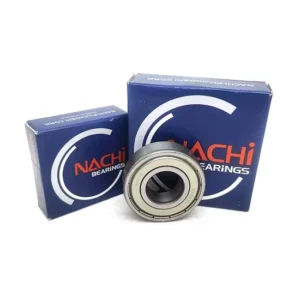
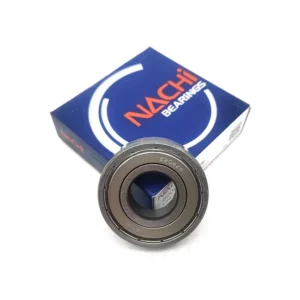
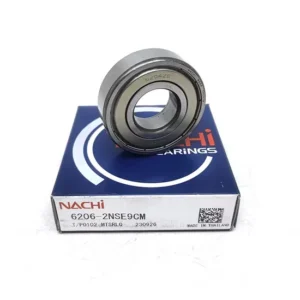
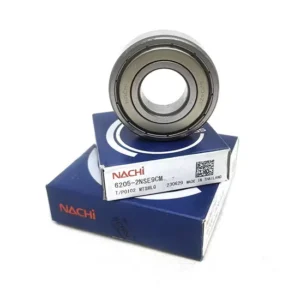
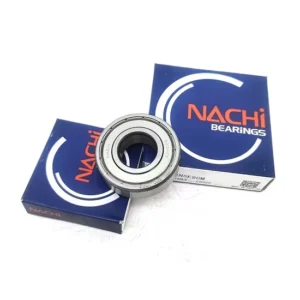
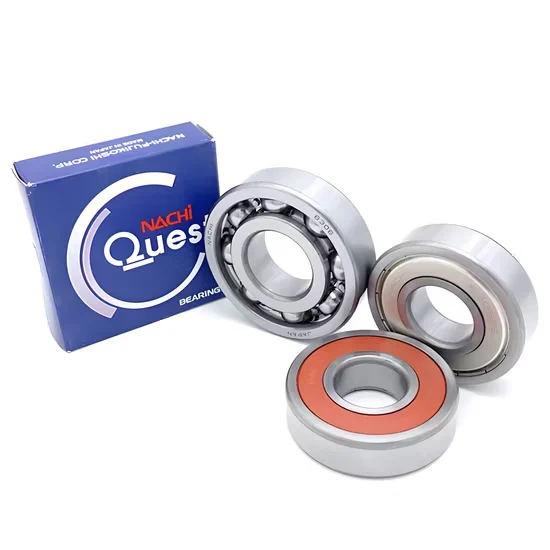
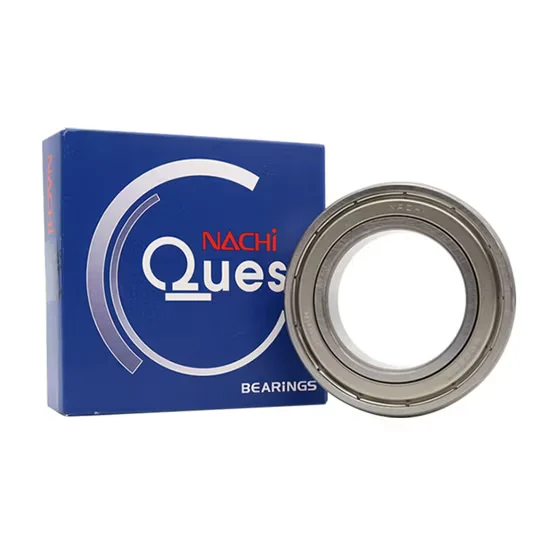
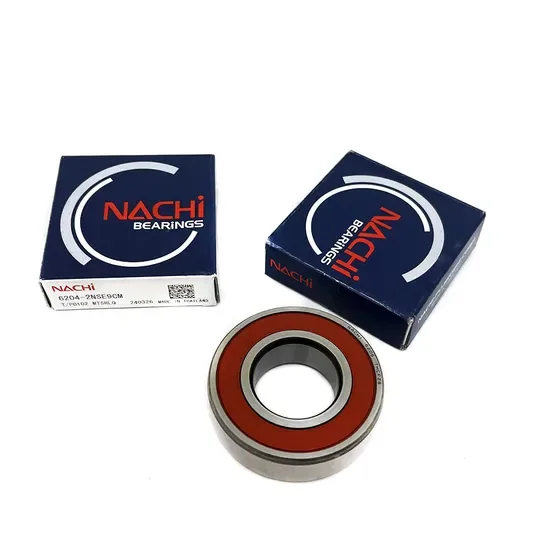
Original Batch Traceability — Every NACHI 6203 6205 6204 6301 6000 6201rs deep groove ball bearing ships with verifiable factory lot documentation.
Technical Specifications
| Parameter | Value |
| Designation | 6203 6205 6204 6301 6000 6201rs |
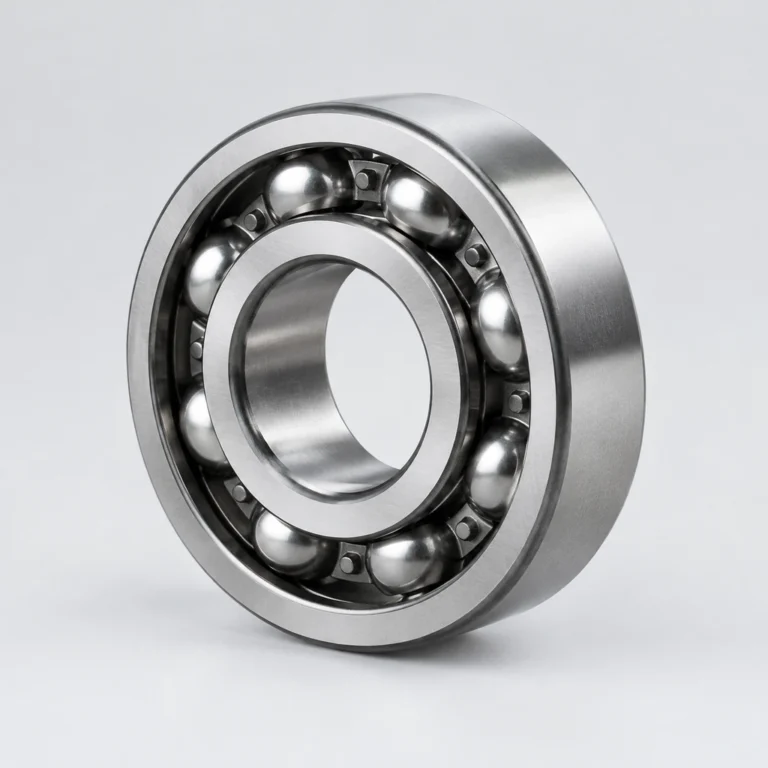
| Bearing Type | Deep Groove Ball Bearing |
| Rows Number | Single Row |
| Seal or Shield Type | Zz 2RS Open |
| Precision Rating | P0 P6 P5 P4 |
| Material | Bearing Steel |
| Lubrication | Grease or Oil |
| Vibration | Z1V1 Z2V2 Z3V3 Z4V4 |
| Load Direction | Radial Bearing |
Application Suitability
| Industry | Typical Applications |
| Machine Tools | High-speed spindle supports and precision feed mechanisms |
| Electric Motors | Rotor shaft supports requiring low-noise operation |
| Pumps & Reducers | Impeller shafts and gear reduction radial supports |
| General Manufacturing | Conveyor rollers and automated assembly line MRO replacements |
When Standard Suffixes Cause Spindle Seizures in NACHI 6203 6205 6204 6301 6000 6201rs deep groove ball bearing Applications
Overlooking clearance and precision grades turns a routine replacement into catastrophic downtime.
Early in my career at a Suzhou grinding workshop, a client installed a standard unit without verifying the exact suffix requirements for a high-speed machine tool spindle. The resulting overheating and seizure caused severe production delays and expensive housing repairs. Sourcing the correct NACHI 6203 6205 6204 6301 6000 6201rs deep groove ball bearing requires strict attention to application conditions to prevent such failures. Machine tool environments demand exact alignment between the internal geometry and the operational thermal profile. When maintenance teams treat these components as generic commodities, they risk introducing microscopic runout that accelerates wear.

Aligning Precision and Sealing for Machine Tool Demands
Selecting the right NACHI 6203 6205 6204 6301 6000 6201rs deep groove ball bearing depends heavily on matching the seal type and precision class to the specific machine tool environment. Our technical team provides cross-brand equivalent model consultation to ensure the selected unit handles the required radial loads while maintaining tight dimensional tolerances. This consolidated sourcing approach eliminates the guesswork when consolidating mixed-model MRO packages. By analyzing the specific cutting forces and rotational speeds of your equipment, we can identify whether a standard P0 unit suffices or if a P4 precision variant is mandatory to maintain surface finish quality on the machined parts.
Managing Thermal Expansion and Contamination in Spindles
High-speed spindle operations generate significant friction heat, making the correct internal clearance critical to accommodate thermal expansion without preload loss. Choosing between Zz shields and 2RS contact seals involves balancing dust protection against the friction heat generated at elevated rotational speeds. Proper lubrication selection, whether grease or oil, directly impacts the operational lifespan under these demanding conditions. Oil lubrication is often preferred for high-speed machine tool spindles to dissipate heat effectively, while grease offers maintenance-free operation for sealed electric motor applications. Ignoring these thermal dynamics can lead to rapid degradation of the lubricant film.
Decoding Suffixes and Vibration Standards for Optimal Performance
The "rs" suffix in the 6201rs indicates a single contact seal, providing targeted protection on one side while leaving the other open for specific lubrication or mounting needs. Precision ratings ranging from P0 to P4 dictate the running accuracy, where P4 is essential for minimizing runout in precision machine tool spindles. Vibration standards from Z1V1 up to Z4V4 define the acoustic and dynamic smoothness, ensuring low-noise operation for electric motors and sensitive equipment. Selecting the appropriate bearing steel construction ensures structural integrity under continuous radial loading. Understanding these suffixes prevents the common mistake of installing a fully sealed unit in an application that requires oil mist lubrication, which would otherwise starve the rolling elements.
The Operational Impact of Mismatched Tolerances and Seals
Installing a unit with incorrect vibration grades or mismatched seal types leads to unplanned downtime and premature failure. According to failure mode classifications, improper sealing allows contaminant ingress, which rapidly degrades the raceway surface and causes abrasive wear. Relying on standard replacements without verifying precision classes can result in catastrophic damage to the spindle housing and adjacent tooling. Furthermore, utilizing a unit with inadequate vibration control in high-speed electric motors generates excessive acoustic noise and harmonic resonance, ultimately compromising the structural integrity of the entire assembly.
Securing Genuine Traceability and Technical Alignment
We supply genuine original bearings with complete traceability documentation, ensuring every 6201rs or 6000 unit is authentically sourced and verified. Our massive spot inventory covers thousands of standard part numbers, allowing flexible MOQ from single-unit emergency spares to full container consolidation. We provide cross-brand equivalent model consultation, which is crucial when replacing obsolete machine tool components with modern equivalents. Furthermore, our technical selection support helps verify exact suffix alignments, preventing the costly clearance mismatches I witnessed early in my career. Global shipping consolidation ensures your mixed-brand packages arrive efficiently, backed by long-term after-sales technical support for failure analysis and application guidance.
Documentation & Authenticity
- Certificate of Conformity verifying the genuine NACHI or X&S origin for each batch.
- Original factory batch traceability documents linking the 6203 and 6205 units to specific production runs.
- Anti-counterfeiting authentication guidance via official App or QR code for field verification.
- Dimensional inspection reports confirming P4 and P5 tolerance limits before dispatch.
- Material certificates validating the bearing steel composition for high-load applications.
Storage, Handling & Mounting
- Keep the 2RS sealed units in their original packaging to prevent moisture ingress before installation.
- Use clean gloves when handling P4 precision variants to avoid transferring skin oils to the bearing steel surfaces.
- Store open-type units in a climate-controlled environment to preserve the factory-applied rust preventive coating.
- Verify the exact Zz shield alignment during mounting to avoid deforming the metal shields.
- Apply the recommended grease or oil lubrication immediately after unsealing open variants for pump applications.
Engineering Review for Your Specific Application
To ensure optimal performance, please share your radial load, operating speed, and temperature parameters for accurate L10 life calculation. Providing the exact OEM equipment number allows our engineering team to perform precise cross-reference verification and identify any historical design updates. Detail your environmental exposure to dust, coolant, or moisture so we can recommend the most suitable seal type and clearance class. This collaborative technical review ensures that the final selection perfectly aligns with your operational demands and maintenance schedules.
Frequently Asked Questions
Q: How do I verify the authenticity of the received deep groove ball bearings?
A: You can authenticate the units using the manufacturer's official App or by scanning the QR code on the packaging. We also provide original factory batch traceability documents and a Certificate of Conformity. This ensures every 6203 or 6205 unit is genuinely sourced and fully traceable to its production run.
Q: What is the difference between Zz shields and 2RS contact seals for machine tools?
A: Zz shields offer non-contact protection, generating less friction and suiting high-speed spindle applications. In contrast, 2RS contact seals provide superior dust and moisture exclusion but introduce slightly higher friction. Choosing between them depends on balancing the need for contamination protection against the thermal limits of your specific machine tool operating speeds.
Q: How do P0 to P4 precision classes correlate with ABEC standards?
A: The P0, P6, P5, and P4 precision ratings roughly correspond to ABEC 1, 3, 5, and 7 standards, respectively. Higher precision classes like P4 guarantee tighter dimensional tolerances and better running accuracy. This is critical for minimizing vibration and runout in high-speed electric motors and precision machine tool spindles.
Q: How do Z1V1 to Z4V4 vibration standards affect motor noise levels?
A: These standards classify the vibration and acoustic performance of the bearing. A higher rating, such as Z4V4, indicates strictly controlled surface finishes and tighter manufacturing tolerances, resulting in noticeably smoother and quieter operation. This is essential for applications like household appliances and sensitive electric motors where low-noise performance is a strict requirement.
Q: What are the regreasing recommendations for open-type variants in pump applications?
A: Open-type bearings require external lubrication and must be properly greased or oiled during installation based on the pump's operating speed and load. Regular regreasing cycles should be established based on the operating temperature and environmental contamination levels. We provide technical selection support to help determine the optimal lubricant type and maintenance interval for your specific setup.