
NACHI Bearing Technical Guide Applications & Industries
Genuine NACHI Bearings for Food Mixers – Wholesale Supplier
Prevent water ingress and costly downtime in food mixers by selecting genuine NACHI bearings with robust sealing. This guide details critical selection criteria for waterproof bearings and food-grade lubrication. Learn to verify supplier authenticity through traceability documents to ensure hygiene compliance and operational reliability.
- Published
- By author
- nachioem · Specialized NACHI bearing supplier
Stainless steel housings alone do not guarantee bearing survival in food processing environments.
Selecting genuine NACHI bearings with appropriate sealing configurations and NSF-approved food-grade lubrication is the definitive strategy to prevent water ingress and ensure continuous operation in industrial food mixers. The critical failure point is rarely the load capacity but the integrity of the seal against high-pressure washdowns, making authentic component sourcing non-negotiable for hygiene compliance and operational reliability.
In the humid, high-contamination zones of food production, standard industrial bearings fail rapidly. I have seen procurement teams prioritize initial unit cost over sealing specifications, only to face catastrophic line stoppages. The reality on the factory floor is that water and cleaning agents penetrate inadequate seals, washing out lubricant and introducing contaminants. This leads to premature fatigue and potential product contamination.. Understanding the specific demands of mixer applications requires moving beyond generic part numbers to verified, application-specific solutions.
Why Do Food Mixers Demand Specialized Bearings?
The combination of high radial loads and aggressive daily washdowns creates a unique failure environment that standard bearings cannot withstand.
Food mixers operate under conditions that are mechanically and chemically hostile. Unlike dry industrial applications, these machines are subjected to high-pressure water jets, steam, and caustic cleaning agents multiple times per shift. The primary challenge is not just supporting the heavy dough or liquid loads but maintaining a hermetic barrier against moisture ingress..
I recall a palm oil processing facility where the main shaft bearings on large industrial mixers failed repeatedly. The maintenance team assumed that because the housing was stainless steel, the internal components were safe. However, the bearings used lacked robust sealing mechanisms suitable for direct water exposure. During daily washdowns, water bypassed the standard shields, emulsified the grease, and caused rapid corrosion of the rolling elements. The resulting downtime cost the plant significantly more than the price difference between standard and specialized sealed bearings would have been.
The core issue lies in the seal design. Standard metal shields offer minimal protection against liquid ingress. For food mixers, bearings require contact seals made from materials compatible with food-safe standards and resistant to cleaning chemicals. These seals must maintain flexibility and integrity despite temperature fluctuations and mechanical stress.. Without this specific protection, even high-quality steel will corrode from the inside out, leading to unexpected failures.
Furthermore, the lubrication itself must be food-grade. In the event of a seal breach, non-toxic lubricants prevent product contamination. This requirement narrows the selection pool significantly, demanding bearings that can operate effectively with specialized greases that may have different viscosity characteristics than standard industrial oils.
How to Select the Right NACHI Bearing for Mixers?
Matching the seal type and lubrication specification to the specific mixer shaft conditions is more critical than selecting the highest load rating.
Choosing the correct bearing involves analyzing three key parameters: sealing effectiveness, lubrication compatibility, and load capacity under wet conditions. A mismatch in any of these areas compromises the entire assembly.
| Selection Criteria | Standard Industrial Bearing | Food-Grade Mixer Bearing (NACHI) |
|---|---|---|
| Sealing Type | Metal Shield (ZZ) or Light Contact Seal | Robust Rubber Contact Seal (e.g., V-ring or specialized lip) |
| Lubrication | Standard Lithium Complex Grease | NSF H1 Registered Food-Grade Grease |
| Corrosion Resistance | Basic Rust Prevention | Enhanced Surface Treatment or Stainless Steel Components |
| Water Ingress Protection | Low (IP54 or lower) | High (Designed for washdown environments) |
| Traceability | Often Limited | Full Batch Traceability Available |
The table above highlights the qualitative differences essential for decision-making. Note that “Robust Rubber Contact Seal” refers to designs that provide a physical barrier against liquids, unlike metal shields which only block large particles..
A dough mixer OEM I worked with recently upgraded their standard bearing specification to include sealed NACHI units with pre-applied food-grade grease. The goal was to extend relubrication intervals and reduce maintenance frequency. By selecting bearings with superior seal integrity, they minimized the risk of grease washout during cleaning cycles. This change did not increase the initial manufacturing cost prohibitively but significantly reduced the warranty claims related to bearing failure.
When selecting NACHI bearings for these applications, verify the suffix codes indicating seal types and lubrication. Ensure the supplier provides documentation confirming the grease meets relevant food safety standards.. It is not enough to assume a bearing is “food safe”; verification through official documentation is mandatory for compliance audits.
Additionally, consider the shaft fit and housing design. Even the best bearing will fail if the housing allows water to pool around the seal. Proper installation practices, including correct alignment and avoiding damage to the seal lips during mounting, are crucial for long-term performance.
What Are the Hidden Costs of Counterfeit Bearings?
Cheaper, non-genuine bearings save upfront costs but cause exponential losses in production downtime and product contamination risks.
The market is flooded with counterfeit bearings that mimic the packaging and appearance of premium brands like NACHI. These imitations often use inferior steel, poor heat treatment, and substandard seals. In food processing, the consequences of using such components are severe.
A beverage factory maintenance team once replaced failed bearings with what they believed were genuine NACHI parts sourced from an unauthorized distributor. Within weeks, the seals degraded, allowing water and bacteria to enter the bearing housing. This led to contamination of the product batch, resulting in a massive recall and regulatory scrutiny. The cost of the recall dwarfed the savings from purchasing cheaper bearings..
Counterfeit bearings typically fail due to:
- Inadequate Seal Material: Using non-food-safe rubber that degrades quickly when exposed to cleaning agents.
- Poor Steel Quality: Leading to premature fatigue and spalling under load.
- Incorrect Lubrication: Using industrial grease that is toxic if it leaks into the product zone.
The hidden costs include not just the replacement part but the labor for emergency repairs, lost production time, and potential legal liabilities from contamination. Authentic NACHI bearings undergo rigorous quality control to ensure consistency in material purity and dimensional accuracy.. This consistency is absent in counterfeit products, making them a gamble with operational stability.
Moreover, counterfeit bearings often lack proper traceability. In the event of a failure analysis, there is no way to verify the manufacturing batch or material certificates. This lack of transparency complicates root cause analysis and prevents effective corrective actions.
How to Verify Genuine NACHI Bearings During Sourcing?
Requiring full traceability documents and verifying authorized supplier status is the only reliable method to ensure component authenticity.
Sourcing genuine NACHI bearings requires a proactive approach to verification. Relying solely on price or packaging appearance is insufficient. Buyers must demand comprehensive documentation that links the physical product to its manufacturing origin.
Key verification steps include:
- Request Certificate of Origin: Ensure the document specifies the manufacturing country and batch number.
- Check Traceability Codes: Genuine NACHI bearings often have laser-etched codes on the ring or packaging that can be verified with the manufacturer.
- Verify Supplier Authorization: Confirm that the supplier is an authorized distributor or has a direct supply chain from the manufacturer..
- Inspect Packaging Quality: Look for high-quality printing, correct logos, and security features such as holograms or unique serial numbers.
A recent case involved a MRO buyer who suspected counterfeit bearings in a shipment. By requesting the full traceability documentation, they discovered discrepancies in the batch numbers provided by the supplier. This prompted a deeper investigation, revealing that the supplier was mixing genuine and fake stock. Switching to a supplier with transparent, verifiable supply chains eliminated this risk.
Technical support is also a indicator of authenticity. Reputable suppliers offer engineering assistance to help select the correct bearing for specific applications. They can provide technical datasheets, load calculations, and installation guides. This level of support is rarely available from traders dealing in counterfeit goods.
When sourcing NACHI bearings for food mixers, prioritize suppliers who can provide complete documentation and technical expertise. This ensures that every bearing installed meets the stringent requirements of food safety and operational reliability.
Conclusion
Authenticity and sealing integrity are the pillars of reliable food mixer operation.
Selecting genuine NACHI bearings with proper sealing and food-grade lubrication prevents costly downtime and ensures hygiene compliance. Verifying supplier authenticity through traceability documents protects against the hidden risks of counterfeit components. Prioritizing these factors secures long-term operational efficiency and product safety.
Products in this article
NACHI bearings mentioned above
These are the NACHI bearing types discussed in this guide. Open a product page to check its designation and send the exact suffix with your quantity.
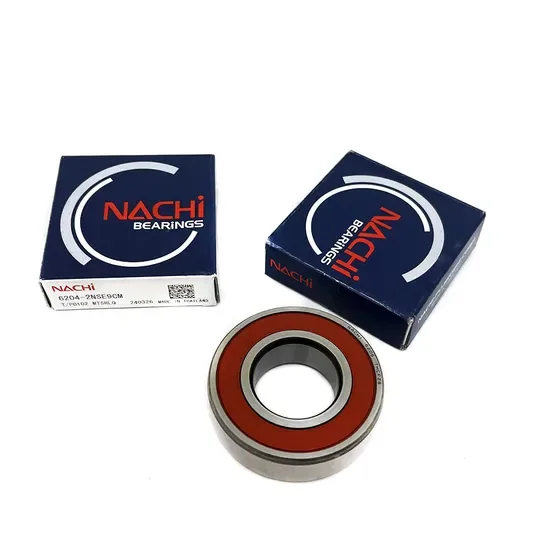
Deep Groove Ball Bearings
Genuine NACHI 608zz 6202 6201 Deep Groove Ball Bearing for Marine Equipment
View product Deep Groove Ball Bearings
Genuine NACHI P6 Deep Groove Ball Bearings 62208 62210 63002 63004 63006
View product
Deep Groove Ball Bearings
Genuine NACHI Deep Groove Ball Bearings 6215 6216 6217 6218 6219 for Juicer
View product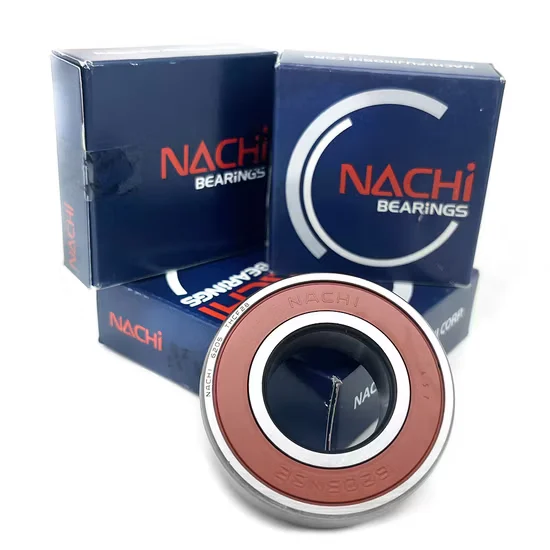
Deep Groove Ball Bearings
Genuine NACHI Deep Groove Ball Bearing 6408 6409 6410 6411 6412 for Conveyor
View productModel check
Not sure which NACHI designation fits? We help with substitution, cross-reference and selection.
Send the old bearing number, the worn marking you can still read, or the application and shaft size. nachioem matches it to the correct NACHI model, including clearance, cage and seal options, before you order.
- Substitution for discontinued models
- Cross-reference to NACHI numbers
- Selection for spindles, pumps and reducers
Keep reading
Related NACHI bearing technical articles
More practical guides on NACHI suffixes, replacement and selection for machine tools, automotive, construction machinery, pumps and gear reducers.
Oct 7, 2026 · Applications & Industries · 8 min read
Genuine NACHI Bearings for Hydraulic Pumps – Wholesale Supplier
Prevent thermal seizure in hydraulic pumps by selecting genuine NACHI bearings with precise C3/C4 clearance classes. Learn from real-world failure cases and verify traceability…
Read the article Oct 7, 2026 · Applications & Industries · 7 min read
NACHI Bearings for Woodworking Machines Wholesale Supplier
Prevent costly spindle seizures in high-speed woodworking machines by selecting the correct NACHI bearings with C3 or C4 clearance. Learn how to match ZZ…
Read the article Oct 7, 2026 · Applications & Industries · 8 min read
Genuine NACHI Bearings for Plastic Machines – Wholesale Supplier
Genuine NACHI bearings for plastic machines prevent catastrophic downtime caused by improper clearance in high-temperature zones. Learn to select the right series for extruders…
Read the article
Request a quote
Send your NACHI model list. We quote fast.
List the NACHI model numbers with full suffixes and the quantity for each. nachioem replies online as quickly as possible with pricing for distributors, repair shops and end users worldwide.
- info@nachioem.com
- WhatsApp +1 (702) 981-5880
- Online replies as quickly as possible
- Global delivery by DHL, FedEx, UPS, air or sea