
NACHI Bearing Technical Guide Technical Resources
NACHI to Other Brands Interchange Table: Cross-Reference Supplier for Sale
Master the NACHI interchange table by verifying internal clearance and cage materials, not just dimensions. Matching C3 clearance and brass cages prevents thermal seizure in high-load applications. Validate tolerance grades to ensure reliable cross-brand replacements for SKF, FAG, and NSK equivalents.
- Published
- By author
- nachioem · Specialized NACHI bearing supplier
Matching outer diameter and bore size is not enough to guarantee bearing interchangeability.
True NACHI to other brands interchange requires verifying internal clearance classes, cage material specifications, and tolerance grades alongside external dimensions. Relying solely on dimensional equivalence often leads to premature failure in high-load or high-temperature applications because internal geometry dictates operational lifespan.
When I first started handling industrial bearing procurement, a German client urgently needed a replacement for a NACHI deep groove ball bearing on an assembly line. I provided a substitute based strictly on the outer diameter, inner diameter, and width. The dimensions matched perfectly. Within weeks, the new bearing seized due to thermal expansion closing up the internal clearance. The production line halted, resulting in a mid-six-figure loss. That incident reshaped my approach. Now, every cross-reference check begins with the assumption that dimensions are merely the baseline for entry, not the guarantee of performance. This methodology ensures that when you consult a NACHI interchange table, you are comparing functional equivalents, not just geometric lookalikes.
Why Dimensional Matching Fails in Real Applications?
External dimensions such as bore, outside diameter, and width are standardized across major manufacturers like SKF, FAG, NSK, and NACHI. However, these metrics do not account for the internal environment where the actual mechanical work occurs. Two bearings with identical external measurements can have vastly different internal clearances, leading to catastrophic mismatches in specific operating conditions.
Consider a high-temperature assembly line scenario. A standard C0 (normal) clearance bearing may operate smoothly at room temperature. But when the housing expands due to heat, the internal clearance reduces. If the replacement bearing does not match the original’s C3 or C4 clearance specification, the rolling elements will bind. This is not a defect in the bearing; it is a defect in the selection process.
| Feature | Standard Dimensional Check | Full Technical Interchange |
|---|---|---|
| External Dimensions | Verified | Verified |
| Internal Clearance | Ignored | Matched (C2/C3/C4) |
| Cage Material | Assumed Standard | Specified (Steel/Brass/Polymer) |
| Tolerance Grade | Assumed P0 | Verified (P0/P6/P5) |
| Lubrication Type | Not Checked | Matched to Application |
In many cases, distributors provide a basic NACHI to SKF FAG NSK bearing cross reference that lists only part numbers and sizes. This creates a false sense of security. For instance, a NACHI 6205 might be listed as equivalent to an SKF 6205. But if the NACHI unit is a C3 clearance variant designed for electric motors, and the SKF replacement is a standard C0 clearance unit, the motor will overheat.
The key takeaway is that dimensional matching is necessary but insufficient. Without verifying the internal specifications, you are gambling with equipment reliability. This is why a comprehensive NACHI interchange table must include data on clearance and tolerances, not just size.
How to Verify Internal Clearance and Tolerances?
Internal clearance refers to the distance between the rolling elements and the raceways. It is critical for accommodating thermal expansion and load distribution. Tolerance grades define the precision of the bearing’s manufacturing. Misaligning either parameter can cause vibration, noise, and early failure.
To verify these parameters, you must look beyond the base part number. Manufacturers use suffixes to denote these specifications. For example, a NACHI bearing with a C3 suffix has greater internal clearance than a standard unit. When cross-referencing, you must ensure the replacement brand uses the same clearance class. Similarly, tolerance grades like P0, P6, and P5 indicate increasing levels of precision. A P5 grade bearing from NACHI cannot be replaced by a P0 grade from another brand in a precision spindle application, even if the dimensions are identical.
Steps to Verify Clearance and Tolerances:
- Identify the Original Suffixes: Check the existing NACHI bearing for codes like C3, C4, P5, or P6. If the marking is worn, consult the original equipment manual or the machine’s design specifications.
- Cross-Reference Clearance Classes: Use a detailed NACHI to other brands interchange table to find the equivalent suffix in the target brand. Note that some brands use different coding systems. For example, what one brand calls CN might be standard in another. Always confirm the actual micron range of the clearance.
- Match Tolerance Grades: Ensure the replacement bearing meets the same ISO tolerance class. For general industrial use, P0 is common. For machine tools or high-speed applications, P5 or P6 may be required.
- Validate Load Ratings: While not always part of the basic interchange, dynamic and static load ratings should be comparable. A lower load rating in the replacement can lead to fatigue failure under heavy loads.
A European wind farm operator once faced repeated gearbox failures. They were replacing NACHI spherical roller bearings with equivalents from another brand. The dimensions and clearance matched, but the tolerance grade was overlooked. The replacement bearings had slightly higher runout, causing misalignment in the gearbox. This led to uneven load distribution and premature spalling. Switching to a verified P5 equivalent resolved the issue.
Verifying these internal specs transforms a guess into a calculated engineering decision. It prevents the subtle failures that dimensional checks alone cannot predict.
Which Cage Materials Suit Your Specific Environment?
The cage, or retainer, holds the rolling elements in place. Its material determines the bearing’s suitability for speed, temperature, and vibration. Standard steel cages are robust but may not perform well in high-temperature or high-speed scenarios. Brass cages offer better wear resistance and are suitable for moderate speeds. Polymer cages, such as those made from polyamide, are lightweight and allow for higher speeds but have temperature limits.
Ignoring cage material is a common oversight when using a basic NACHI interchange table. A standard steel cage might fail in a high-heat environment where a brass or phenolic cage would survive. Conversely, a polymer cage might deform under heavy shock loads where a steel cage would remain intact.
Cage Material Selection Guide:
- Steel Cages: Suitable for general industrial applications with moderate speeds and temperatures. Robust and cost-effective.
- Brass Cages: Ideal for higher temperatures and moderate speeds. Offers good wear resistance and is less prone to seizure than steel in certain conditions.
- Polymer Cages: Best for high-speed applications due to low weight. Limited by temperature thresholds and chemical compatibility.
In a heavy-load conveyor application, a mining company replaced NACHI bearings with equivalents that had standard steel cages. The original bearings used brass cages. The new steel cages experienced increased friction and heat buildup, leading to frequent downtime. Switching back to brass-caged equivalents reduced downtime noticeably. This highlights that cage material is not a minor detail; it is a critical performance factor.
When consulting a NACHI to SKF FAG NSK bearing cross reference, always check the cage material suffix. If the original bearing has a brass cage, ensure the replacement does too. This simple check can prevent significant operational disruptions.
How to Validate the Interchange Before Bulk Ordering?
Before committing to a large order, it is essential to validate the interchangeability of the selected bearing. This involves requesting traceability documentation and conducting sample testing. Traceability docs confirm the bearing’s origin, manufacturing date, and specifications. Sample testing allows you to verify fit, clearance, and performance in the actual application.
Validation Process:
- Request Documentation: Ask the supplier for certificates of conformity and material test reports. These documents should verify the bearing’s compliance with ISO standards and the specified clearance and tolerance grades.
- Inspect Samples: Visually inspect the sample bearings for markings, surface finish, and cage material. Measure the internal clearance if possible using feeler gauges or dial indicators.
- Test Fit: Install the sample bearing in the application. Monitor temperature, vibration, and noise during initial operation. Compare these metrics with the performance of the original NACHI bearing.
- Consult Technical Support: Engage with suppliers who offer cross-brand technical consultation. They can provide insights into specific application requirements and help identify potential issues before they occur.
A Middle East steel mill implemented this validation process when switching suppliers for their rolling mill bearings. By testing samples and reviewing traceability docs, they identified a discrepancy in the heat treatment process of the replacement bearings. This prevented a potential batch failure that could have halted production for days.
Validating the interchange ensures that the replacement bearing will perform as expected. It mitigates the risk of unforeseen failures and provides confidence in the supply chain.
Conclusion
Dimensional equivalence is only the starting point for true bearing interchangeability.
Successful replacement of NACHI bearings with other brands requires a holistic approach that includes internal clearance, tolerance grades, and cage materials. By moving beyond basic size matching and verifying these critical parameters, you can ensure reliable performance and avoid costly downtime. A detailed NACHI interchange table is a valuable tool, but it must be used with an understanding of the underlying engineering principles. Always validate your selections through documentation and testing to guarantee operational success.
Applications covered in this article
Products in this article
NACHI bearings mentioned above
These are the NACHI bearing types discussed in this guide. Open a product page to check its designation and send the exact suffix with your quantity.
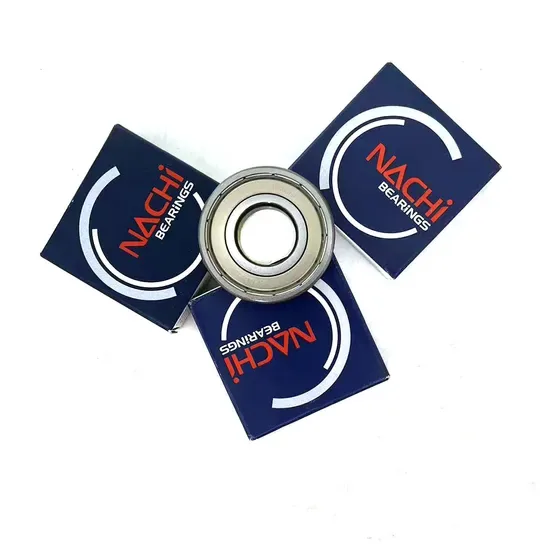
Deep Groove Ball Bearings
NACHI Non-Magnetic Deep Groove Ball Bearing 608 6204 6205 6206 6207 6208 6317 6318 6319 6320
View product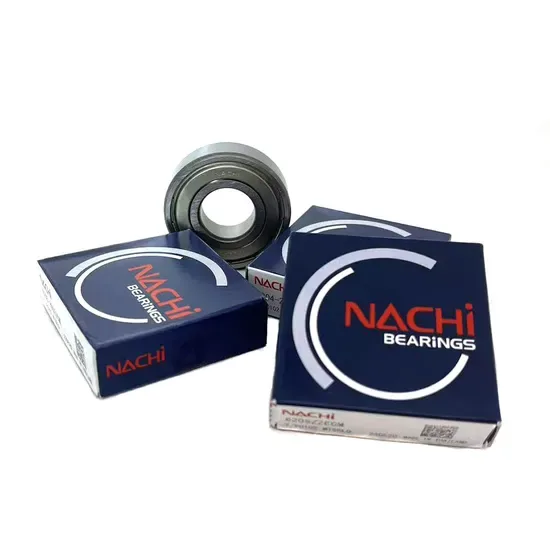
Deep Groove Ball Bearings
NACHI Deep Groove Ball Bearing 681 682 6202 683 684 685 686 6203 687 688 6205
View product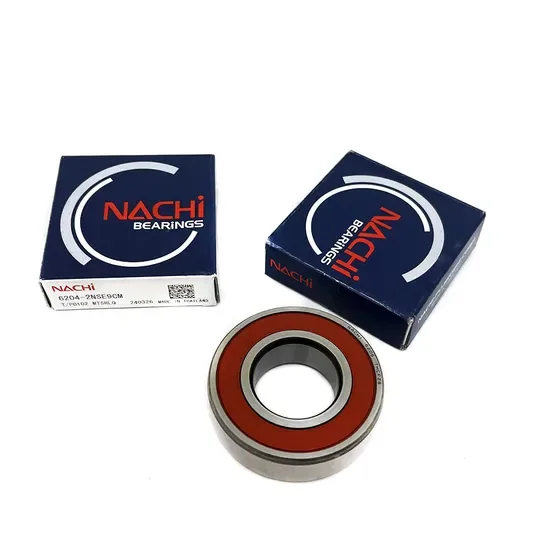
Deep Groove Ball Bearings
NACHI Deep Groove Ball Bearing 6004 6204 6002 6205 6203 6011 6300 6310 6305 6913 6912 6911 6910 6909 6908
View product Deep Groove Ball Bearings
X&S NACHI Electric-Insulated Deep Groove Ball Bearing 6313 6205CE for Dental Turbine
View productModel check
Not sure which NACHI designation fits? We help with substitution, cross-reference and selection.
Send the old bearing number, the worn marking you can still read, or the application and shaft size. nachioem matches it to the correct NACHI model, including clearance, cage and seal options, before you order.
- Substitution for discontinued models
- Cross-reference to NACHI numbers
- Selection for spindles, pumps and reducers
Keep reading
Related NACHI bearing technical articles
More practical guides on NACHI suffixes, replacement and selection for machine tools, automotive, construction machinery, pumps and gear reducers.
Oct 8, 2026 · Technical Resources · 9 min read
NACHI Bearing Glossary: Wholesale Supplier for Bulk Orders
Master the NACHI Bearing Glossary to prevent costly spindle failures caused by misinterpreting suffix codes. Distinguish between standard DB pairing and custom Flush Ground…
Read the article
Oct 8, 2026 · Technical Resources · 7 min read
NACHI Precision Bearing Wholesale Supplier & Bulk Stock
Prevent premature failure by matching NACHI precision bearing internal clearance and cage materials to heavy-load conditions. Learn to calculate thermal expansion effects, select vibration-resistant…
Read the article Oct 8, 2026 · Technical Resources · 7 min read
NACHI Mounted Unit Dimension Table Wholesale Supplier
Stop costly downtime by mastering the NACHI Mounted Unit Dimension Table for precise installation. Verify center height, bore diameter, and mounting hole pitches to…
Read the article
Request a quote
Send your NACHI model list. We quote fast.
List the NACHI model numbers with full suffixes and the quantity for each. nachioem replies online as quickly as possible with pricing for distributors, repair shops and end users worldwide.
- info@nachioem.com
- WhatsApp +1 (702) 981-5880
- Online replies as quickly as possible
- Global delivery by DHL, FedEx, UPS, air or sea