
NACHI Bearing Technical Guide Technical Resources
NACHI Spherical Bearing Dimension Table – Wholesale Supplier
Stop costly installation jams by using the NACHI Spherical Bearing Dimension Table to verify updated housing fit tolerances and internal clearance. Match exact shaft dimensions and load ratings to prevent premature failure. Ensure structural compatibility and long-term machinery reliability with precise ISO standard cross-referencing.
- Published
- By author
- nachioem · Specialized NACHI bearing supplier
Most engineers assume dimension tables are static reference lists. They are not. The NACHI spherical bearing dimension table is a dynamic engineering tool where housing fit tolerances and internal clearance specifications evolve to match modern load demands. Ignoring these updates turns a simple replacement into a catastrophic installation failure.
The complete NACHI spherical bearing dimension table provides the exact shaft and housing fits, internal clearance classes, and misalignment limits required to prevent installation jams and premature bearing failure. Relying on legacy drawings without verifying current tolerance standards leads to immediate operational downtime. Accurate cross-referencing of part numbers against updated ISO standards is the only way to ensure structural compatibility and long-term machinery reliability.
I still remember the dust choking the air at a quarry crushing line in Riyadh. The maintenance team had ordered replacements based on a decade-old schematic. They ignored the updated housing fit tolerances listed in the current NACHI spherical bearing dimension table. When the new units arrived, they jammed during press-fit installation. The entire quarry operation halted for days while we sourced correct fittings and verified the shaft dimensions. That incident taught me that the dimension table is not just a list of numbers; it is the lifeline of your machinery.
Understanding these specifications prevents costly errors. Let us break down how to use this data effectively.
What Are the Key Dimensions in the NACHI Table?
Inner diameter, outer diameter, and width are the primary structural identifiers, but basic load ratings dictate actual performance compatibility. Many buyers focus solely on physical size, overlooking the dynamic and static load capacities that define whether a bearing can survive its application.
The NACHI spherical bearing dimension table organizes these critical parameters systematically. For OEM engineers and MRO buyers, matching these values ensures the bearing fits the mechanical design intent. A mismatch in load rating, even with perfect physical dimensions, leads to rapid fatigue failure.
| Parameter | Description | Engineering Significance |
|---|---|---|
| Inner Diameter (d) | Shaft fitting size | Determines rotational stability and torque transmission |
| Outer Diameter (D) | Housing fitting size | Defines radial space and housing interference fit requirements |
| Width (B) | Axial thickness | Influences axial load capacity and mounting space constraints |
| Dynamic Load Rating (Cr) | Fatigue life indicator | Predicts service life under rotating loads |
| Static Load Rating (Cor) | Deformation limit | Prevents permanent deformation under stationary heavy loads |
A cement plant conveyor operator once faced repeated bearing failures despite using correct physical sizes. The issue was not the dimensions but the load rating. They had selected a standard series instead of the heavy-duty variant specified in the updated NACHI spherical bearing dimension table. The dynamic load rating was insufficient for the shock loads generated by the conveyor. Switching to the correct series extended the service life meaningfully.
When reviewing the NACHI spherical bearing dimension table, always cross-check the load ratings against your application’s actual operating conditions. Do not assume that a physically identical bearing from a different series offers the same performance.
How Do Updated Tolerances Prevent Installation Jams?
Modern housing fit tolerances differ significantly from legacy drawings, making verification of shaft and housing classes mandatory before ordering. Most failures during installation stem from assuming that old tolerance classes remain valid.
The NACHI spherical bearing dimension table reflects periodic updates to optimize load distribution and reduce stress concentrations. Housing fits typically follow ISO standards such as k6 or m6 for shafts and H7 or J7 for housings. Using an outdated drawing might specify a looser fit that causes slippage or a tighter fit that leads to cracking during installation.
In a mining OEM project, mixed-brand sourcing created confusion. The engineering team needed to cross-reference dimensions to ensure batch consistency. By strictly adhering to the tolerance classes in the NACHI spherical bearing dimension table, they avoided lead time delays and ensured that all bearings met the same precision standards.
| Fit Type | Standard Class | Application Context | Risk of Incorrect Fit |
|---|---|---|---|
| Shaft Fit | k6 / m6 | Rotating inner ring | Loose: Slippage and fretting corrosion; Tight: Inner ring cracking |
| Housing Fit | H7 / J7 | Stationary outer ring | Loose: Outer ring rotation and wear; Tight: Housing distortion |
| Internal Clearance | C3 / C4 | High temperature or heavy load | Insufficient: Overheating and seizure; Excessive: Vibration and noise |
Verifying these classes against the current NACHI spherical bearing dimension table prevents the “jamming” scenario I witnessed in Riyadh. Always measure the actual shaft and housing dimensions on-site rather than relying solely on paper specifications. Wear and machining variations can shift fits outside acceptable tolerances.
What Is the Step-by-Step Verification Process?
Cross-checking part numbers, measuring actual fits, and confirming internal clearance before mounting is the only reliable method to ensure successful installation. Skipping any step invites failure.
First, identify the exact part number from the existing bearing or machinery manual. Use this number to locate the specific entry in the NACHI spherical bearing dimension table. Do not rely on visual similarity alone.
Second, measure the shaft and housing dimensions using calibrated micrometers. Compare these measurements against the tolerance classes listed in the NACHI spherical bearing dimension table. If the shaft is worn beyond the k6 or m6 limit, it must be repaired or sleeved before installing the new bearing.
Third, confirm the internal clearance class. Applications with high thermal expansion or heavy loads often require C3 or C4 clearance. The NACHI spherical bearing dimension table specifies these options. Selecting the wrong clearance leads to overheating or excessive play.
A European wind farm operator reduced unplanned downtime by implementing this verification process. They previously installed bearings based on part numbers alone. After adopting the step-by-step check against the NACHI spherical bearing dimension table, they identified several cases where shaft wear had compromised the fit. Correcting these issues before mounting prevented immediate failures.
- Identify Part Number: Locate the exact model from the machinery manual or existing unit.
- Consult Dimension Table: Retrieve current specs from the NACHI spherical bearing dimension table.
- Measure Fits: Verify shaft and housing dimensions against ISO tolerance classes.
- Check Clearance: Confirm C3 or C4 clearance requirements based on operating conditions.
- Inspect Seals: Ensure seal compatibility with the housing design to prevent contamination.
This process ensures that every bearing installed meets the engineering requirements for longevity and performance.
Why Do Spherical Bearings Fail Despite Self-Alignment?
Exceeding the dimension table’s misalignment angle limits overrides the self-aligning feature, causing internal friction and overheating. Many users believe spherical bearings can compensate for any degree of misalignment. This is a dangerous misconception.
The NACHI spherical bearing dimension table includes specific limits for angular misalignment. These limits are determined by the bearing’s internal geometry and seal design. Exceeding these angles causes the rollers to skew, leading to edge loading and rapid temperature rise.
In a steel mill application, a conveyor pulley was misaligned due to foundation settling. The maintenance team relied on the self-aligning capability of the spherical bearings. However, the misalignment exceeded the limits specified in the NACHI spherical bearing dimension table. The bearings overheated and failed within weeks. Correcting the alignment and selecting bearings with appropriate misalignment capabilities resolved the issue.
| Factor | Impact on Performance | Mitigation Strategy |
|---|---|---|
| Misalignment Angle | Exceeding limits causes edge loading | Verify alignment against table limits; use laser alignment tools |
| Internal Friction | Increases with skewing rollers | Ensure proper lubrication and clearance selection |
| Seal Integrity | Compromised by excessive angulation | Select seals designed for higher misalignment if needed |
Understanding these limits is crucial. The NACHI spherical bearing dimension table provides the data needed to assess whether a bearing can handle the expected misalignment. If the application exceeds these limits, mechanical correction of the shaft or housing is necessary before installing the bearing.
Conclusion
Accurate interpretation of the NACHI spherical bearing dimension table prevents installation errors and extends machinery life. It is not merely a reference but a critical engineering document.
Verify shaft and housing fits against current tolerance standards. Confirm load ratings and internal clearance match your application’s demands. Respect misalignment limits to avoid overriding the self-aligning feature. These steps ensure reliable performance and minimize costly downtime.
Applications covered in this article
Products in this article
NACHI bearings mentioned above
These are the NACHI bearing types discussed in this guide. Open a product page to check its designation and send the exact suffix with your quantity.

Spherical Roller Bearings
NACHI 22311 Self Aligning Roller Bearing Spherical Motorcycle Parts
View product
Spherical Roller Bearings
NACHI 22210 Spherical Roller Bearing for Metallurgical Equipment Japan
View product
Spherical Roller Bearings
NACHI 22222 Self-Aligning Roller Bearing Japan Origin Spherical
View product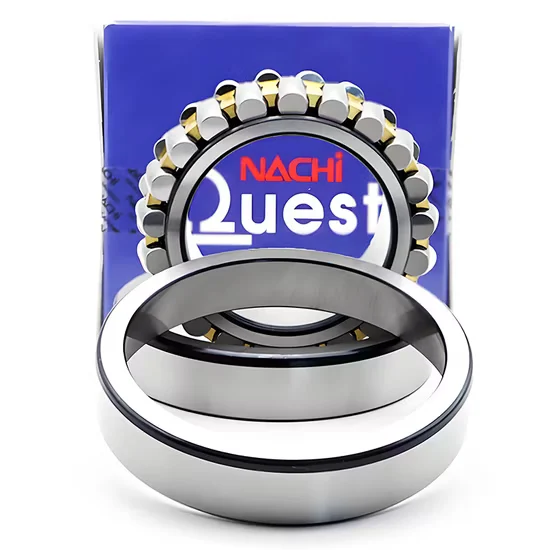
Spherical Roller Bearings
NACHI 24072cdke4 24076cdke4 24080cdke4 Spherical Roller Bearing Self-Aligning
View productModel check
Not sure which NACHI designation fits? We help with substitution, cross-reference and selection.
Send the old bearing number, the worn marking you can still read, or the application and shaft size. nachioem matches it to the correct NACHI model, including clearance, cage and seal options, before you order.
- Substitution for discontinued models
- Cross-reference to NACHI numbers
- Selection for spindles, pumps and reducers
Keep reading
Related NACHI bearing technical articles
More practical guides on NACHI suffixes, replacement and selection for machine tools, automotive, construction machinery, pumps and gear reducers.
Oct 8, 2026 · Technical Resources · 9 min read
NACHI Bearing Glossary: Wholesale Supplier for Bulk Orders
Master the NACHI Bearing Glossary to prevent costly spindle failures caused by misinterpreting suffix codes. Distinguish between standard DB pairing and custom Flush Ground…
Read the article
Oct 8, 2026 · Technical Resources · 7 min read
NACHI to Other Brands Interchange Table: Cross-Reference Supplier for Sale
Master the NACHI interchange table by verifying internal clearance and cage materials, not just dimensions. Matching C3 clearance and brass cages prevents thermal seizure…
Read the article
Oct 8, 2026 · Technical Resources · 7 min read
NACHI Precision Bearing Wholesale Supplier & Bulk Stock
Prevent premature failure by matching NACHI precision bearing internal clearance and cage materials to heavy-load conditions. Learn to calculate thermal expansion effects, select vibration-resistant…
Read the article
Request a quote
Send your NACHI model list. We quote fast.
List the NACHI model numbers with full suffixes and the quantity for each. nachioem replies online as quickly as possible with pricing for distributors, repair shops and end users worldwide.
- info@nachioem.com
- WhatsApp +1 (702) 981-5880
- Online replies as quickly as possible
- Global delivery by DHL, FedEx, UPS, air or sea